


Head Ball 2 - Online Soccer
Masomo Gaming
Head Ball 2 - Online Soccer is the kind of sports game I can open with no preparation and understand within seconds. The idea is simple: two players face each other, move around a compact pitch, and try to send the ball past the opponent. That simplicity is exactly what makes it approachable, but the small arena also leaves very little room for careless decisions. A missed jump, a badly timed strike, or an overconfident attack can change the match immediately.
I reviewed it as a quick competitive game rather than as a traditional football simulation. It does not try to reproduce a full eleven-a-side match, detailed tactics, or a long campaign built around realistic management. Instead, it turns soccer into a direct duel where reactions, positioning, and timing matter more than complicated controls. For me, that makes it a strong fit for short sessions, although players looking for a calm or highly realistic football experience may find its pace and presentation too exaggerated.
The game is free to download and sits in the sports category. Masomo Gaming is the developer, and its broad reach is reflected in an average rating of 4.5 from around 2.5 million ratings, with over 100 million installs. It is rated for Everyone, runs on devices using Android 6.0 or later, and the current version is 1.633. Those details make it accessible to a wide range of players, but the competitive design still deserves a closer look before you decide whether it suits your habits.
Related News
Head Ball 2: The Arcade Soccer Sensation Redefining Mobile Sports

Head Ball 2: The Whimsical Soccer Showdown You Can't Miss

Hunter Assassin: Mastering Stealth and Strategy on Mobile
Why the first match feels so immediate
My first impression came from how quickly the game gets to its central action. There is no need to learn a long list of commands before playing. The controls are built around movement, jumping, and striking, so I could concentrate on reading the ball and the other player instead of searching through menus. That low entry barrier is useful when I want a match during a break, while waiting for transport, or when I simply do not want to invest time in a large sports game.
The compact field gives every movement a visible consequence. In a conventional football game, a mistake can be hidden by the size of the pitch or corrected by another teammate. Here, the duel puts responsibility almost entirely on me. If I move too far forward, I may leave the goal exposed. If I wait too long, the opponent can take control of the next bounce. This creates a satisfying feeling of personal responsibility, even though the controls themselves remain easy to grasp.
Related News

Why WhatsApp Messenger Still Makes Everyday Communication Feel Easy

Jurassic World: The Game Is the Better Dino Tycoon for Strategic Players

Threads in Real Life: Who Should Join, Lurk, or Leave

How SHEIN Turned Shopping Into an Endless Content Feed

How to Make Fortnite Feel Smarter on Mobile

Should You Switch to Microsoft Outlook on Mobile?
Matches are also helped by their clear objective. I am not managing a squad, adjusting a formation, or learning a complicated set-piece system. I am trying to win the next exchange. That focus makes the game readable for newcomers and gives experienced players a straightforward way to test their reflexes. The trade-off is that the experience can feel repetitive if I am expecting the variety of a full football game.
The most important adjustment is to stop treating every ball as an invitation to attack. Early on, I often moved toward the ball automatically and ended up out of position. A better habit is to watch where the ball will land and keep enough distance to react to a deflection. In a one-on-one format, patience is not passive play; it is a way to make the opponent commit first.
A cartoon pitch with a competitive edge
The visual direction supports the game’s accessible personality. Characters and environments use a bright, playful style rather than aiming for broadcast realism. That choice helps the action remain easy to read on a small screen, especially when the ball is moving quickly or both players are close together. The exaggerated look also makes the game feel less like a serious simulation and more like an animated arcade contest.
Gallery
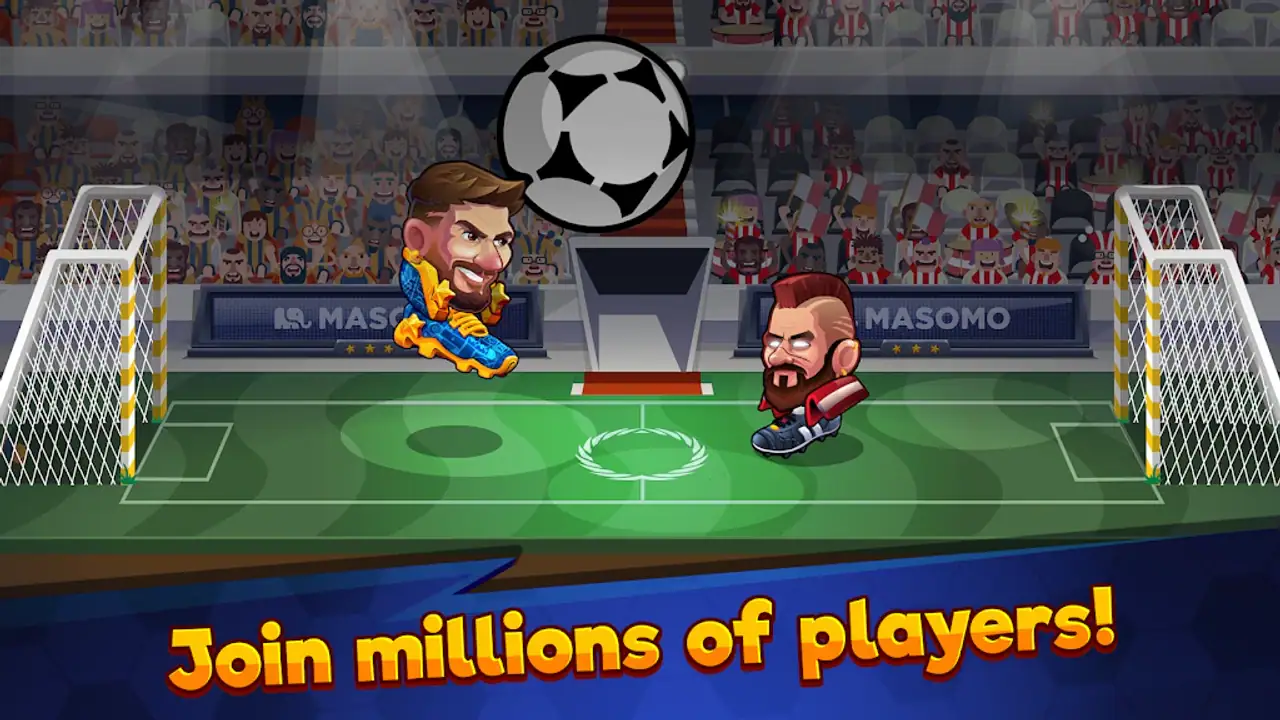
That art direction is not merely decoration. The simplified setting keeps my attention on the duel. I am not distracted by a large stadium presentation, detailed player likenesses, or a complex tactical interface. The field becomes a stage for quick decisions, and the characters give each match a little personality without changing the basic goal.
At the same time, the playful presentation can make defeats feel sharper than expected. The game looks friendly, but the competitive structure is not especially gentle once both players understand how to control space. A new player may enter because the visuals seem casual and then discover that repeated losses can arrive quickly. I think it works best when approached as an arcade competition, not as a relaxed children’s football toy.
The setting also affects how I read momentum. A clean, uncluttered arena makes sudden changes easy to notice: the ball rises, a player jumps, and the next touch can send it toward either goal. Because the visual language is so direct, I can usually identify the reason for a mistake. That clarity is valuable when practicing, since I can ask whether I mistimed the jump, stood in the wrong place, or attacked without cover.
How sound and pacing shape each duel
The game’s mood comes from the combination of quick exchanges, energetic presentation, and a constant sense that the next touch matters. I do not experience it as a slow build toward a final moment. Instead, every possession feels like a small event. A ball near the goal creates immediate pressure, while a defensive clearance can reset the situation without making the match feel completely calm.
That rhythm is one of the strongest reasons I return to it. A short session can contain several distinct emotional turns: confidence after a clean save, panic when the ball bounces awkwardly, and relief when a late strike finds the goal. The pacing keeps the match moving, but it also means I need to accept that a result can change quickly. Players who dislike sudden reversals may find the same energy frustrating.
Sound works best as a companion to that rhythm rather than as the main attraction. The action is easy to follow visually, while the audio helps reinforce contact, danger, and the general arcade atmosphere. I prefer playing with sound available because it makes the matches feel more active, but I can still understand the core action when I need to play quietly. For a mobile game designed around quick rounds, that balance is practical.
One useful habit is to treat the pace as something I can manage rather than something that controls me. When the ball is moving toward my goal, rushing forward usually makes the situation worse. I get better results by taking a fraction of a second to identify whether the opponent is attacking high, low, or from a rebound. The game rewards fast reactions, but it also rewards not panicking.
Where the mechanics fit—and where they do not
The central mechanics suit the one-versus-one format because they create a clear contest between attack and defense. I am constantly deciding whether to challenge the ball, protect the goal, or wait for a better angle. There is no teammate to cover a mistake, so positioning becomes as important as the button press itself. That makes the game more demanding than its cheerful appearance suggests.
The controls are approachable, but mastery is a different matter. Knowing how to move is not the same as knowing when to move. I found that many exchanges were decided before the final strike, because one player had already claimed the more useful position. Staying near the center of the action without drifting too far from the goal gives me more options than chasing every bounce.
Another practical lesson is to use the walls and rebounds as part of the situation instead of viewing them as random interruptions. A direct shot is not always the safest choice. Sometimes a controlled touch creates a more favorable angle, while an impulsive strike gives the opponent an easy response. The small arena makes these details visible, and repeated play gradually turns them into habits.
The game is especially suitable for people who enjoy competitive mobile sessions with a low learning curve and a high ceiling for timing. It can also work for friends who want a quick challenge without agreeing to a long match. I would be more cautious recommending it to someone who wants realistic player movement, full-team coordination, or a manager’s control over transfers and tactics. Those players may prefer a conventional football simulation, where the satisfaction comes from building attacks across a larger field.
It is also not the best choice for someone who becomes irritated by online competition. The one-on-one structure makes the opponent’s influence impossible to ignore, and a poor connection or a mismatch in experience can affect how fair a match feels. Even when I play well, I have to accept that the format is built around direct confrontation. There is no way to hide in a supporting role.
Progress, spending, and the practical trade-off
The game is free, which makes trying it straightforward, but it includes in-app purchases ranging from $0.49 to $249.99 per item. I would approach those purchases carefully. The competitive appeal comes from improving my decisions and timing, so spending should not replace learning how to defend space or read the ball. Anyone installing it for a child should be aware that the free entry point and optional purchases are different parts of the experience.
My advice is to play enough matches to understand whether the core duel is genuinely enjoyable before considering any purchase. If I still enjoy the game when matches go badly, that is a better sign than being attracted only by unlocks or visual rewards. The format is strongest when the focus stays on the immediate contest, and unnecessary spending can make a quick arcade game feel more complicated than it needs to be.
The current version, 1.633, is useful to know when checking compatibility or comparing the experience on different devices. Android support begins with version 6.0, so the game is not restricted to only the newest phones. Even so, the most important practical question is not simply whether it installs; it is whether the device and connection can keep fast online exchanges feeling responsive. A game based on timing benefits from a stable setup.
For an everyday example, I can imagine opening it during a ten-minute break. I might play one match, notice that I am repeatedly leaving the goal unprotected, and use the next match to focus only on positioning. That makes the session feel purposeful without requiring a long commitment. If I lose several times in a row, however, the same short-session design can encourage me to keep trying when I would be better off taking a break.
How it compares with other football choices
Compared with a full football simulation, this game removes almost everything that slows the route to action. There are no large squads to control during a match and no need to direct an entire team across a full-sized pitch. I get a more concentrated test of reactions and positioning. The price of that immediacy is reduced realism and less strategic variety outside the duel itself.
Compared with casual offline sports games, the online one-versus-one structure gives each result more weight. Playing against another person can make a simple exchange feel meaningful, because the opponent adapts instead of following a predictable pattern. It can also make the experience less relaxing. If I want a game I can play without pressure or without depending on another player’s connection, a slower offline alternative may be a better fit.
Compared with football management games, the difference is even larger. Head Ball 2 is about what I do in the next few seconds, not about planning a season or balancing a club. That makes it a poor substitute for management fans, but a good complement for someone who wants immediate control. I would choose it when I want to play football, not when I want to run a football organization.
The game’s strongest identity comes from combining a cartoon world with a surprisingly focused competitive loop. The setting says “pick up and play,” while the mechanics quietly ask me to improve. That contrast is effective because it welcomes beginners without removing the possibility of serious practice. It also explains why the experience can appeal to both a casual player and someone who enjoys testing small mechanical advantages.
Who should install it and who should pass
I recommend it to players who like short online contests, clear controls, and matches where individual mistakes are easy to understand. It is a good option for someone who wants a sports game that feels active immediately, especially if full football simulations seem too demanding or time-consuming. Its Everyone rating also makes it broadly approachable in terms of presentation, though younger players may still need guidance around competitive play and optional spending.
I would skip it if my priority were realism, quiet pacing, or a deep team-building system. I would also think twice if losing a close match tends to spoil my mood, because the direct duel leaves little room to recover emotionally from a mistake. The game is most enjoyable when I can treat each match as practice, accept quick reversals, and avoid turning every result into a judgment of my skill.
One of the less obvious strengths is how clearly it exposes decision quality. In many sports games, success can be spread across several players and systems. Here, I can identify patterns in my own play: chasing too much, jumping too early, or attacking when the safer option was to wait. That makes improvement feel concrete. I am not merely hoping to become better; I can choose one behavior to correct in the next match.
Its main limitation is the narrowness that creates that clarity. Once I have spent time with the duel, I may want more variation than the small-field format can provide. The game can remain entertaining through competition, but it does not offer the same breadth as a title built around full matches, team development, or a larger range of football situations. That is not a flaw in execution so much as a boundary of its design.
My final view of the atmosphere and the play
Head Ball 2 works because its art direction, sound, and pacing all point toward the same goal: make a soccer duel easy to enter and hard to master. The bright presentation keeps the game friendly, the compact setting keeps the action readable, and the quick rhythm gives every touch a sense of urgency. Underneath that approachable surface is a competitive experience that asks for patience, timing, and better positioning.
I enjoy it most when I play in short bursts and give each match a specific purpose, such as defending more carefully or waiting for a rebound instead of forcing a shot. That approach turns the game from a sequence of wins and losses into a small training loop. It also protects the experience from becoming an endless chase after the next result.
For me, this is a convincing free sports game for players who want direct online competition rather than a realistic football simulation. Its broad audience, accessible controls, and energetic mood make it easy to recommend, while the online pressure, optional purchases, and limited one-on-one scope deserve honest consideration. If you want a quick soccer duel with room to improve, this is worth trying; if you want a full football world, choose a different kind of game.
FAQs for Head Ball 2 - Online Soccer
What are the main features of Head Ball 2?
Head Ball 2 offers a fast-paced, exciting soccer experience with one-on-one matches. Players can upgrade and customize their characters, participate in leagues, and battle against friends or online opponents worldwide. The game also features special powers and unique stadiums to enhance the gameplay experience.
Is Head Ball 2 free to play?
Yes, Head Ball 2 is free to download and play on both Android and iOS devices. However, it contains in-app purchases that allow players to buy items, characters, and upgrades. These purchases are optional, but they can enhance the gameplay by unlocking additional features and customizations.
How does the multiplayer mode work in Head Ball 2?
The multiplayer mode in Head Ball 2 allows players to compete against others in real-time online matches. You can challenge friends or match with players globally. The game uses a matchmaking system to pair players with opponents of similar skill levels, ensuring competitive and fair gameplay.
What are the system requirements for Head Ball 2?
To run Head Ball 2 smoothly, ensure your device meets the minimum system requirements. For Android, a version of 4.1 or higher is needed, while iOS devices require iOS 9.0 or later. Adequate storage space and a stable internet connection are also essential for optimal performance.
Are there any tips for beginners in Head Ball 2?
For beginners, it's crucial to focus on mastering the controls and timing your moves effectively. Utilize special powers wisely and upgrade your character to improve skills. Participating in leagues and events can also offer valuable rewards and experience. Practice regularly to enhance your gameplay strategy.
Pros
- Engaging real-time multiplayer matches.
- Wide variety of characters and upgrades.
- Simple controls with intuitive gameplay.
- Frequent updates with new features.
- Lively graphics and animations.
Cons
- In-app purchases can be pricey.
- Occasional connectivity issues.
- Advertisements interrupt gameplay.
- Limited offline mode options.
- Can be repetitive over time.


